Situated at the lower end of old Bear Valley-Hornitos roll road, a favored artery of travel from and to the San Joaquin Valley, the Northrup bnrothers encountered more than their share of unusual characters.
In 1864, during the summer of their acquisition of Jersey Ranch, John Northrup wsa shot at by Joseph Hill, a resident of Merced River, while diverting the water of Burns Creek to his orchards. A newspaper of the day stated that John was seriously, though not fatally wounded, in the assault. That incident may have been the final blow which left the unfortunate man all but bed-ridden. An examination of the ranch deed reveals that the "Jersey Boys" had the guaranteed legal right to the scant water resources of Burns Creek.
The following year, John Northrup married Annie Marie Simmons, a daughter of his neighbor William Simmons of Mount Gaines. In 1866, the first of six children were born to the newlyweds. Because of his brother's handicap, Moses Northrup found himself in the difficult position of providing for the need of the entire household. Still, there was no visible animosity between the Northrup brothers.
One day during the summer of 1867, a neighbor, David Evans, called at the Northrup ranch on his way into Hornitos. Evans was an emigrant from Wales who had settled in Mariposa county in 1855 with his wife, Mary. While he maintained a friendly rapport with his neighbors, Evans, then in his fifties, nevertheless had the reputation of being quite an eccentric, unpredictable man.
"Take a look at this peach from my Cotton Creek orchard," Evans bragged to Northrup, "have you ever seen one so big before?" "Hell, that's nothing," replied Northrup said, and turned to his wife. "Annie dear, go down to the flat and pick out a sample of our peaches. We grow the largest on any form south of the Merced River."
Cheerfully, young Annie jogged to one of the peach trees, unaware that Evans had followed her. In the act of reaching up to pick some of the fruit, Evans caught her by the shoulder and threw her on the ground, grumbling something about not having any children. At the same moment he tried forcefully to kiss her.
"Don't ever try that on me!" Annie Northrup responded, biting him on the arm until the blood started. At this, Evans relented. From that day forward, Evans found no reason to darken the doorway of the Jersey Ranch.
About one year later, an unidentified person came to the Evans ranch while he was away. His dog was shot dead and two barns on the premises were burned to the ground. At first Evans blamed the act on some former hands with whom he'd worked, but soon he circulated a rumor among their neighbors to the effect that Moses Northrup had committed the act in revenge for Evans' abuse of Annie Northrup.]
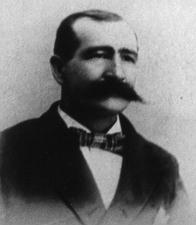
In September of 1877, some nine years later, John Northrup sent Charles Pollard, a paid employee, to haul some wood to the Jersey Ranch. This job required the teamster to traverse a road which partially dissected Evans' property. On his approach Pollard was met by an irate Evans, who displayed his shotgun threateningly, instructing the driver to go back. Loudly, he decreed that no team of Northrup's was permitted to pass over his land.
 |
On learning this, John Northrup, with Pollard's assistance, went over to the house of Evans in hopes of learning why his team was forbidden from using a road which Evans had designated for public use.
"Your brother, that sneaking coward," shouted Evans, "burned my barns and killed my dog! He's a thief and a liar. He carries a pistol around but won't dare to use it, but I'll fix him." Northrup confronted Evans over the insult to his wife, saying if he'd done the same to Evans' wife, he would have been shot on sight. "Let the past be past," he urged, "stop bothering my team, and we'll call it a draw." Yet Evans persisted. "No!" he continued, "I'll never allow you to freight over my land! You and Moses are of the same stock. Neither of you are any good." Evans then challenged John Northrup to a duel while threatening to shoot down brother Moses "like a dog" within ten days.
Following the altercation Northrup returned to his home and later notified his brother of all that had transpired. The idea of suing their neighbor for slander was discussed, but eventually forgotten.
On September 24, 1877, Moses Northrup armed himself, and in company of Charles Pollard, who had witnessed the meeting of Evans and Northrup, rode the few miles to the Evans ranch.
Evans, in the act of cutting wood when they arrived, was approached by Pollard, who handed him anote written by Northrup which stated that the purpose of his visit was nonviolent. Evans discarded the paper, tossing it to the ground. Seeing the note disregarded, Pollard informed Evans that Moses Northrup was waiting to see him.
"He wants to see me does he? I'll fix him," hissed Evans, who advanced toward Northrup and rolling up his fists. Northrup warned him he was close enough to talk and not to come any nearer. Still he continued to manace the visitors, until Moses finally pulled out his pistol. At this, Evans retreated to his house where he obtained a shotgun and returned accompanied by his wife and two witnesses.
Approaching Northrup, Evans aked if he wanted the ground between them measured. To this, Moses replied, "Suit yourself, I'm ready."
Suddenly, David Evans raised his shotgun and fired, hitting the ground in front of Northrup. The charge of lead was followed closely by the report from Northrup's revolver, which found its mark, and Evans fell forward, shot through the head. Through the smoke, the survivor could not tell whether his shot had taken effect, but presently the others called out that Evans was dead.
Gathering his courage, Moses Northrup promptly went to Hornitos where he gave himself up to authorities.
Following a preliminary examination in the court of Justice of the Peace S. W. Carr on September 26, Northrup was bound over to appear before the Grand Jury on a $2500 bond. A warrant was issued for Charles Pollard, present only as a witness to the affair. Made to appear in $1000 bonds, he was unjustly accused of aiding and abetting Northrup in the duel.
The case came to trial in the Thirteenth Judicial District Court on January 5, 1878. The impaneled jury found Moses Northrup guilty of Murder in the Second Degree and recommended him to the mercy of the court. He was handed a ten-year prison sentence. The same jury tried Pollard and returned a gulty verdict. The honorable District Court Judge said he had thought a great deal about the case, however, according to the law, he could do no less than sentence Pollard to ten years in prison. Curiously there was nothing in the evidence to show that he had influenced Northrup in any way.
Sheriff John F. Clarke removed the prisoners from the Mariposa Jail to San Quentin Prison, north of San Francisco, where they were processed and lodged, January 19, 1878.
In an editorial that day, the Mariposa Gazette declared, "We predict that the carnival of crime hitherto rife in our county has ceased, and Mariposa has redeemed herself." Nothing, however, was said about taking up a collection for the children of John Northrup, who without their uncle to provide for them, were left to depend upon their mother, Annie and their helpless father.
February 1, an angry Moses Northrup wrote from San Quentin, "I can truthfully say that I've done more hard work, and worked steadier, and handled more rocks, and laid up more rock fences, and paid more attention to my own business and let others alone, than any other man in Mariposa county....I do not believe in murdering people, or anything else, nor do I consider myself such, for I have done no more than any other noble-minded man would have done under like circumstances."
John Northrup refused to rest. He diligently wrote letters and circulated petitions on behalf of his brother and Charles Pollard. One letter of petition for Executive Clemency contained the signatures of more than one hundred prominent citizens and officials of Mariposa County. His persistence finally paid off. After languishing over four years in prison, Moses Northrup's sentence was finally commuted. He was discharged from San Quentin on May 4, 1881.
Upon returning to his home near Quartzburg, Moses lived out the remainder of his years in the company of his family. Following their passing in the last decade of the nineteenth century, the Northrup brothers were laid to rest within the barbed wire enclosed family cemetery above the Jersey Ranch.
Table of Contents
cotton creek, john northrup, mount gaines, shootouts, duels, ghost towns, 49ers, mariposa, california history, mariposa history, legends, bandits, outlaws, lawmen, desperadoes, mariposa county, mariposa county history, mariposa legends, peace officers, historical express, gold rush hist