The gold excitement brought two groups of African Americans into the Mother Lode region. The first were the free blacks, those who had never known the confines of slavery, or, those who had recently earned their freedom. Hailing mostly from the North, they were relatively well-educated, possessing strong ties to the abolitionist movement, and working as skilled tradesmen and craftsmen. The second group were slaves who traveled west with their masters after being promised an opportunity to earn freedom for themselves and their families.
In 1850, California was admitted into the union as a free state, with slavery being outlawed within its boundaries. But from the very beginning both houses of the legislature were dominated by Democrats from the southern states who quickly passed a number of discriminatory statutes which denied African Americans many constitutional rights including the vote, property ownership, equal educatio for their children, and the right of testimony in a court of law. The Fugitive Slave Law was enforced in the state, and one defiant legislator went so far as to claim that "the black man has no rights that a white man is bound to respect!"
These racist policies aroused many blacks and active agitation began. During the 1850s a series of Colored Citizen Conventions were held, aimed at securing the return of their fundamental rights. Petitions to that effect, bearing the signatures of thousands of both black and white Californians were presented to the governor and legislature, which were promptly disregarded. But the quest for equal rights and a better lifestyle had brought the far-flung members of the black community together. Self-help clubs sprang up in all of the major cities and three black newspapers began publication. Several African American communities started their own schools when their children were not allowed to enter white schools. Even after the Civil War, Emancipation, and the passage of the 14th and 15th amendments, the struggle of the Citizens' Conventions was ongoing. Progress was slow and painful, but thanks to the untiring efforts of black activists throughout the state, all of the organization's avowed goals had been met by 1880.
James Duff would logically be the starting point of any sketch of black pioneers in Mariposa County, as Duff was one of the earliest Negro mining men known to be working on Mariposa Creek when Mariposa was still known as Logtown. In 1849 he helped to install the first quartz rock-crushing mill in the county at the Mariposa Mine, as an employee of John C. Fremont, with whom he'd traveled.
Not far from this mill, at the confluence of Stockton and Mariposa creeks, below the present town of Mariposa, Duff constructed a dam commonly known as Duff's Dam. From this he built a gravity-flow water ditch, a successful method of conveying water for use in washing gravel from the creeks.
Duff purchased a handsome cottage of five good-sized rooms which was situated at the lower end of Mariposa. Attached to the premises was a bath house and a large garden containing at least 25 varieties of beautiful roses.
Duff possessed the trademark of many a happy pioneer--an unflagging sense of humor. He once remarked to an acquaintance: "I was the first white man to settle on Mariposa Creek!" and spoke proudly of his friendship with Fremont.
The 1880 Census enumerates five people in his household: Duff, his wife Adele, a son James, his nephew Charles, and an adopted daughter Mary, who was Caucasian. Although she does not appear on any census, another member of the Duff house was "Polly" Duff, an English-speaking parrot. She enjoyed the freedom of flying about town, and "always knew without fail when and where a church service was to be held." She would perch on the church steeple, laughing and talking to the guests as they entered the church. In 1893 the sad news was passed that the aged "Polly" had died. She was a resident of the Duff house for almost 40 years, and her age was conjectured to be almost 60 years!
James Duff maintained a lifelong interest in, and emphasized the importance of education as a method for African Americans to improve their social, political and economic standing in the community. He was the first Black to serve on the Mariposa School Board and was a representative from the county to the Colored Citizens Conventions and a permanent member of the Committee on Education for that body.
James Duff brought a solid reputation for industry and integrity to the small Negro community which would settle the region. He should be remembered for all time as a founding member of the town of Mariposa, who lovingly devoted much of his time to furthering the struggle for Black rights.
Another well-known family in the African American community in Mariposa were the Monroes: father Lewis and his son George.
Lewis Monroe plied his trade of barber at a small shop in Mariposa during the 1860s and 70s. He was a native of Georgia, who made the trek west during the Gold Rush days. Following a brief period of scraping in the mines, Lewis settled in town and quickly became a favorite among the early pioneers. Following the disastrous fire in August of 1866, which destroyed his shop, the Mariposa Gazette announced that he would still be attending the needs of his customers in the Methodist church building.
Like James Duff, Monroe was active in the fight for racial equality. In addition to attending the Colored Citizens Conventions, he was the local agent for the S.F. Pacific Appeal and The Elevator, early publications for the advancement of Blacks. In 1871 he was the delegate from Mariposa to the State Educational Committee.
Amidst the period in his father's civic activities, the son George Monroe was establishing himself as one of the finest express riders in the state, and during the 1860s was the mail carrier between Merced and Mariposa. The following decade, he was a guide into the Yosemite Valley, which saw hundreds of thousands of visitors each year. Monroe's riding and tracking skills made him a welcome addition to any Sheriff's posse which took to the hills in search of desperadoes.
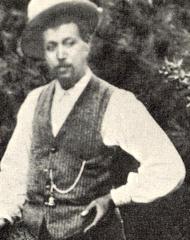 |
| George Monroe |
But the occasion that garnered him the most notoriety was in 1879 when he was called upon for the great honor and responsibility of escorting ex-president and Civil War hero Ulysses S. Grant up the old Wawona Trail into Yosemite Valley. A beautiful meadow in Yosemite Valley was given his name to commemorate his years of active and generous service.
The Bondsmen
A number of slaves and ex-slaves found their way, or were brought into the region, during the early Gold Rush years. A large group brought by Edward and Harriet Brodis, formerly of Howard County, Missouri, settled in the Yaqui Gulch/Carson Creek area. A small colored mining and farming camp existed in the foothills bordering the Gulch during the early days. To date, reference is made to "Nigger Hill" or "Negro Hill" in reference to this community.
The premier example of slaves smuggled in during the 1850s lies in the story of Peter Thorn (aka Peter Green). He was listed in the Census of 1850 as one of ten slaves held illegally by a Colonel Thomas Thorn. The slavemaster was a former cotton planter turned wealthy quartz miner who founded the town of Quartzburg, Mariposa County. He finally freed Green in 1854 after forcing him to remain in servitude for a year after the slave had purchased his freedom for $1,000.
A companion of Green's, Lewis Caruthers, his wife Dianne and their daughters Caroline and Georgeann, suffered in the same way under the stern hand of Colonel Thorn. The Caruthers family lived and toiled at Thorn's hotel and helped nurse the Colonel through his last illness, in 1854. Finally liberated, "Uncle Lewis," well into his fifties, became a successful miner and retired to the colored section of Mariposa where he was "highly respected by his neighbors and acquaintances." He spent his last 20 years in his frame house overlooking Mariposa Creek, tending his little garden. His daughters settled at Hornitos, married prosperous farmers, and raised families of their own.
The life of another ex-slave, Moses L. Rodgers, was, in no uncertain terms, an American success story. Born into slavery in Missouri, young Moses came to California to work in the mines, and after applying himself diligently accomplished himself as a mining engineer.
In 1860 he met and married Ms. Sarah Quivers of Snelling, and in 1869 the couple moved into a newly-constructed log home near the Washington Mine (two miles northeast of Hornitos). Strangely enough, Moses Rodgers had come to prosper in a section of the county that was, before and after the Civil War, vigorously pro-slavery. The Washington Mining Company, of which Rodgers and George Webber were principal partners, had erected in 1867, a 10-stamp mill which ultimately proved to be a major success (ironically this was one of slavemaster Colonel Thorn's first gold mines!). The Washington would ultimately yield upwards of $500,000 worth of gold under Rodger's supervision.
Because of his engineering expertise, Rodgers became a legend in the mining industry, with miners and prospective purchasers traveling hundreds of miles to seek out his opinions. His record in the industry is unparalleled in Mariposa County annals. In the words of a contemporary Merced newspaper: "There is no better mining man in California."
Other mines in which he was interested were the Mt. Gaines Mine and the No. Nine Mine. In these cases, fate had worked an errie conclusion, as the influential Colonel Thorn would have held Rodgers' position, had he lived longer. Rodgers remained active at the Washington Mine until 1896.
Rodgers and his family eventually moved to Stockton where his children were to receive a quality education. There Rodgers invested capital in drilling the first gas lines, and donated land for a public park. He became active in the Colored Citizens Conventions and was a member of the State Educational Committee. His beloved daughter Nettie Rodgers returned to old Hornitos, the center of her father's businesses, and served officially as Postmistress.
Following Moses Rodgers' death on October 9, 1900, a friend wrote a touching eulogy: "I have known Mr. Rodgers a long time and knew him only to respect him....I always regarded him as the whitest man in all my acquaintances in Mariposa County. In all his dealings and business relations in every way he was honorable and as high-toned a man as I have ever met. A gentleman in every sense of the word."
A long and hard-fought battle against racial oppression was won, attributable to perseverance, tenacity, and most importantly, the unity of pioneers of the high calibre of the Monroe, Rodgers and Duff families. It is about time the roles of these courageous individuals, long forgotten in Mariposa's past, have been brought into historical perspective.
Table of Contents
black pioneers, moses rodgers, james duff, colonel thorn, slaves, snelling, mariposa county pioneers, coulterville, ghost towns, 49ers, mariposa, california history, mariposa history, legends, bandits, outlaws, lawmen, desperadoes, mariposa county, mariposa county history, mariposa legends, peace officers, historical express, gold rush history, gold rush ba